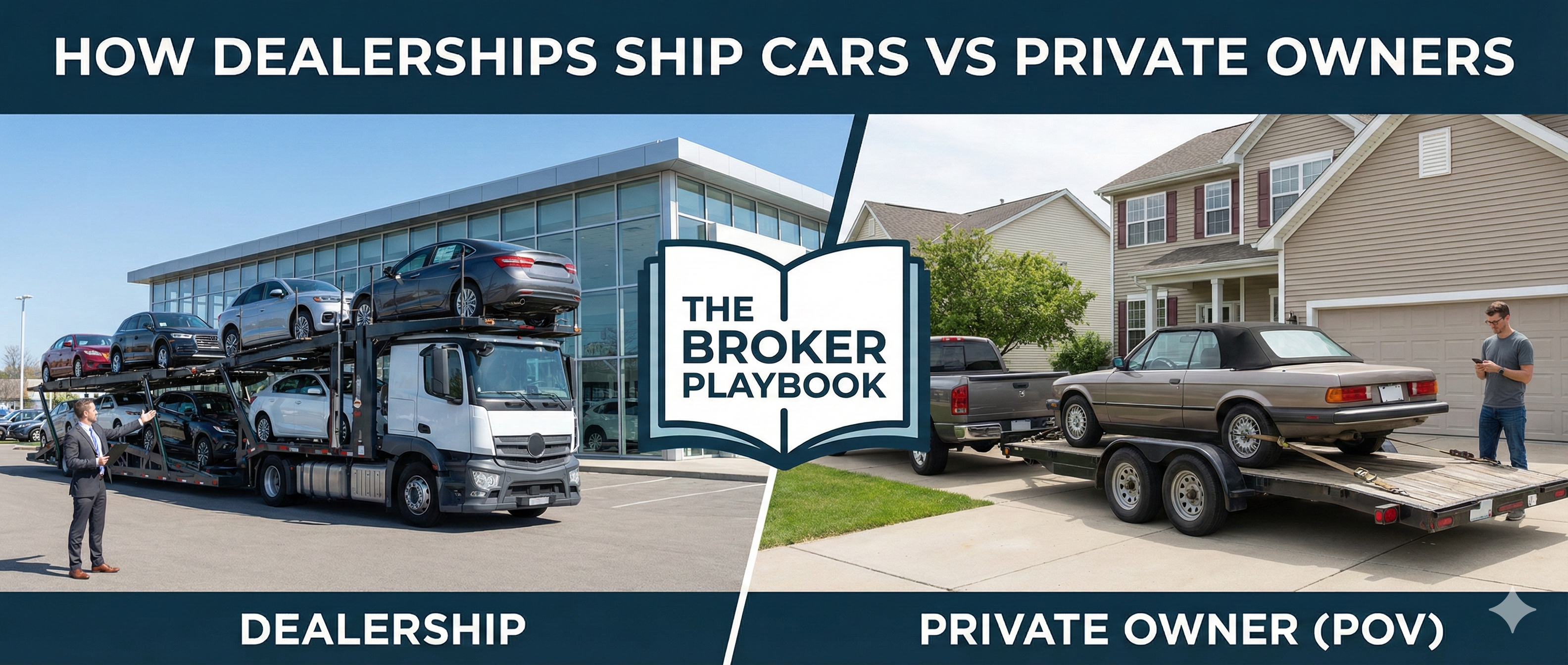
How Dealerships Ship Cars vs Private Owners (POV) — The Broker Playbook
On paper it’s the same service—move a vehicle from A to B. In reality, dealer transport and POV transport behave like two separate businesses with different incentives, timelines, and “failure modes.” If you treat them the same, you’ll leak bookings, margin, and sanity.
Practical, operator-level With visuals & scorecards Designed for modern brokers
Most brokers learn this the hard way. A dealership moves ten units a week with minimal drama, and it feels easy. Then a single private-owner shipment turns into twenty texts, three calls, and a cancellation because the pickup didn’t happen on the exact day the customer pictured in their head.
Same trucks. Same lanes. But the customers are running on different logic. Once you see the difference clearly, you stop trying to “fix” POV customers (they’re not broken), and you start running a workflow that matches the real situation.
The one sentence that changes your operations Dealership shipping is an operations problem. POV shipping is a trust problem.
The two systems (in one chart)
In most broker operations, commercial shipments (dealers, auctions, fleets) make up the larger share of units, while POV creates a disproportionate share of customer-facing work. That doesn’t mean POV is “bad.” It means the job isn’t just moving a car—it’s managing uncertainty in a way the customer can live with.
Dealer vs POV: shipments share (typical broker-observed ranges)
0% 25% 50% 75% 100% Shipments share (typical ranges) Dealers / commercial ~65–75% POV / retail ~25–40% POV often creates disproportionate support work: more updates, more anxiety, more “what’s happening?” moments.
These are common broker-observed ranges (not universal). Swap the percentages with your internal metrics if you want a “hard data” version.
Here’s the important part: you don’t “solve” POV by being more detailed. You solve it by being more structured. The customer doesn’t need a lecture on the market—they need a sense that the process is under control. Dealers already assume that. POV customers don’t.
Operator takeaway: Dealers default to “it’s a process.” POV defaults to “it’s a risk.” Your workflow should reflect that.
Dealer vs POV: the difference in plain English
The easiest way to understand this is to stop thinking about “vehicles” and start thinking about “motives.” A dealership ships cars as inventory. Inventory is replaceable. It’s a business input. A private owner ships a personal asset tied to a move, a job, a family plan, or an expensive purchase. If something goes wrong, it isn’t just delay—it’s disruption.
That’s why the same event (a 24–48 hour pickup delay) barely registers for a dealer but can feel like a crisis for a customer. Not because customers are irrational. Because their stakes are different.
Dimension | Dealership / Commercial | POV / Retail |
|---|---|---|
Primary goal | Move inventory reliably, reduce exceptions | Feel safe, feel certain, avoid regret |
Timing expectation | Window-based thinking is normal | Date-based thinking is the default |
Price psychology | Market-based, adaptive | Anchored to the first quote |
Communication style | Short confirmations, low touch | Proactive reassurance, clear “what next” |
Claims & escalation | Procedural, process-driven | Emotional, trust-driven |
Carrier dynamics | Repeat lanes, repeat workflows | One-off shipments; more unknowns |
If you want a one-line training rule: Dealers want throughput. POV wants confidence.
Big dealer groups: why they’re easier (and stricter) than retail
Large dealer groups ship constantly. Whether it’s dealer-to-dealer transfers, auction moves, overflow balancing, or long-haul inventory shifts, transport becomes a background operational rhythm. That rhythm creates two things: predictability and tolerance. They don’t expect perfection; they expect consistency.
You’ll also notice that “big dealers” can be surprisingly strict in one specific way: they have very little patience for chaos. Not emotional chaos—operational chaos. If pickups are missed without a clean exception path, if paperwork is inconsistent, or if billing is messy, they don’t argue. They replace you.
CarMax AutoNation Lithia Motors Penske Automotive Group 1 Automotive Sonic Automotive Asbury Automotive
In practice, what closes dealer business isn’t a sales pitch. It’s a system: a repeatable lane workflow, a clean window, a clear escalation route, and “quiet competence.” A dealer doesn’t want a relationship. They want a partner that doesn’t create new work for their team.
Dealer mindset in one sentence “Make it predictable and boring.” In dealer transport, boring is premium.
Most common POV locations and lanes (why they cluster)
POV demand doesn’t cluster because customers study freight economics. It clusters because people move. They retire. They change jobs. They buy cars online. They do military PCS. Their kid goes to college. In other words, retail shipping is driven by life events—and life events come with deadlines.
That’s why states like Florida, California, Texas, and Arizona show up over and over again in retail patterns. Not because they’re “better” states, but because they sit at the intersection of population movement and seasonal behavior. The lanes you see most aren’t random either—many are basically seasonal pipelines.
Typical POV demand clusters (examples)
Typical POV demand clusters Driven by life events: relocation, snowbirds, military PCS, college, online purchases Florida snowbirds California moves Texas jobs/PCS Arizona seasonal Common POV lanes (examples) • FL ⇄ NY/NJ (snowbird) • CA ⇄ TX (relocation / buyers) • AZ ⇄ Midwest (seasonal) • Northeast ⇄ Southeast (moves) • Major metros ⇄ college towns (semester cycles) What POV customers actually want • A clear window they can plan around • A simple “what happens next” • Predictable updates • Confidence more than detail
Want a stronger “stats” version? Replace the lane list with your last 90-day booked lanes and add counts.
The lane pattern matters because it affects how you set expectations. A seasonal lane can be great—until you promise certainty. The right approach is not to over-explain the market, but to present the process with confidence: “Here’s the realistic range; here’s the window; here’s how we lock capacity.” That’s what calms the customer down.
Pricing: why dealers accept it and POV customers fight it
Dealers are used to moving inventory in markets. They don’t love price changes, but they understand why they happen. Their world is full of variable inputs: auctions, recon, inventory flow, floorplan timing. Transport is one more moving part. As long as you consistently deliver coverage, they can work with you.
Retail customers are different. They are not “shopping a market.” They are shopping a promise. The first quote becomes the anchor, and every number after that gets compared to it emotionally, not analytically. This is why brokers get trapped trying to defend small differences that are completely normal in a live carrier market.
A framing that prevents 80% of quote drama “This is a live market. I’ll give you a realistic range, and as soon as capacity shows up, we lock the best option.” It sounds confident. It’s honest. And it keeps the customer moving forward.
Notice what that does: it turns your quote into a deliberate strategy, not a guess. You’re not asking the customer to “trust the market.” You’re telling them you know how to operate in it. That’s the entire game on the retail side.
Communication cadence: quiet competence vs proactive reassurance
A lot of brokers try to solve POV anxiety with more messages. That sometimes backfires because “more messages” can look like uncertainty. The goal isn’t volume. It’s predictability. A POV customer can handle “nothing changed” if they know when they’ll hear from you next.
Dealers are the opposite. They don’t want cadence unless there’s an exception. Too many updates create noise, and noise creates operational cost on their side.
Stage | Dealers (low touch) | POV (confidence touch) |
|---|---|---|
After quote | One-line recap + next action | Recap + “what happens next” + window explanation |
Before assignment | Only ping if needed | Scheduled check-in (even if no change) |
En route | Driver ETA is enough | ETA + what pickup will look like |
Delivery | Confirm delivered + billing | Confirm delivered + quick condition reminder + next steps |
If you implement just one thing from this article, implement cadence. It’s one of the highest leverage changes you can make because it reduces inbound “check-in” calls, reduces cancellations, and makes your operation feel controlled.
Two playbooks you can run tomorrow
The easiest way to operationalize this is to stop relying on “agent personality” and start relying on “mode.” In a modern brokerage, the team should be able to switch into Dealer Mode or POV Mode quickly—and your CRM should help, not fight you.
Dealer playbook (throughput mode)
Keep it simple. Dealers want a stable workflow more than they want constant updates. Confirm the essentials once, then run the lane. If there’s an exception, escalate cleanly. The goal is to be the partner that doesn’t create extra work.
Dealer closer line: “We can run this lane consistently with a clean window. Want me to set you up with a repeat workflow?”
POV playbook (confidence mode)
Retail customers don’t need a long interrogation. They need clarity, a realistic range, and a process that feels stable. Ask only what blocks action (running condition, access, hard deadline). Then set a predictable update cadence so they don’t spiral into “what’s happening?”
POV closer line: “If the range works, I’ll start lining up a driver today so you don’t lose capacity.”
One subtle point: in POV mode, you’re not just “selling shipping.” You’re selling the feeling that you’ve done this a thousand times. That’s why confident structure beats endless detail.
Dealer & POV scorecards (copy/paste)
If you manage more than a couple of agents, you’ll see inconsistencies: one person oversells certainty, another overshares detail, another under-communicates. Scorecards help you standardize the decision-making without making everyone sound robotic. They also make training easier because new hires have a clear checklist of what matters.
Dealer shipment scorecard
Use this to standardize “throughput mode” expectations.
Lane repeatability | High / Medium / Low |
Window tolerance | Flexible / Moderate / Strict |
Billing preference | Net terms / Card / Mixed |
Exception protocol | Who to contact + response time |
POV shipment scorecard
Use this to manage risk, reassurance, and deadlines.
Hard deadline | Yes/No (date) |
Running condition | Running / Non-running |
Access type | Residential / Business / Gated |
Customer anxiety level | Low / Medium / High |
Update cadence | Daily / 48h / Only changes |
Why this matters for modern broker ops
Dealers want quiet throughput. POV customers want confidence. The winning workflow isn’t “more messages” or “more scripts” — it’s the right process for the right customer type, consistently applied.
In a modern CRM, this is where automation and AI help most: switching the cadence, framing the price, and preventing handoff chaos.